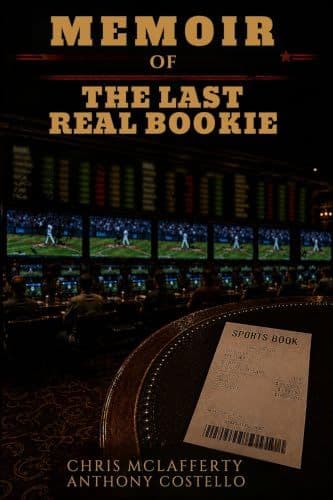
MEMOIR OF THE LAST REAL BOOKIE
by Chris McLafferty Anthony Costello
MEMOIR OF THE LAST REAL BOOKIE is a fictional memoir told in the voice of a man who's earned the right to tell his own story his own way, vernacular, unhurried, and honest to the point of discomfort. Joey "Eyes" Agostino speaks these pages directly to his grandson Albert, and what starts as an old man's recollections slowly reveals itself as something closer to an inheritance: not of money, though there's plenty of that eventually, but of a way of seeing the world that Joey needed a lifetime to earn and now needs someone else to carry forward. The book opens on the blocks of a working-class Chicago neighborhood where family meant everything and nobody had the luxury of pretending otherwise. Joey's childhood is full of small hustles and big lessons, an early, visceral understanding that the street teaches you things no one else will. The death of his cousin Vito is sat with, mourned, turned over the way real grief is turned over years later, still not fully resolved. Richie Cerone appears as a cautionary figure, a man who made different choices with the same street education. His sister Maria stands in contrast, steady, often overlooked in the telling of Joey's own story, but essential to it. From there, the book follows Joey out of the streets and into rooms most people only see on television, most notably the 2003 World Series of Poker, where he falls under the mentorship of Bob Hilo, a figure who teaches Joey that gambling, done right, isn't about luck at all. It's about discipline, patience, and reading people the way Joey already knew how to read a room from childhood. That same discipline extends into a fully formed philosophy of sports betting, tested against real losses and real money, not theory. But this isn't a gambling book, and Joey is careful, deliberately, almost stubbornly, to make sure Albert understands the difference between risk and recklessness. The clearest expression of that difference comes through Dan Shaw, Joey's financial advisor, and the "golden egg," a phrase that starts as a literal description of a retirement account and grows into the book's central metaphor: not the thrill of the bet, but the protection of something that outlasts you. Threaded through all of this is Albert, not a passive listener but an active presence, interrupting with questions that are sometimes sharp, sometimes skeptical, sometimes just funny. These interjections keep Joey honest and slowly reveal that this book is, at bottom, an act of love disguised as a story about poker and betting lines. The later chapters shift the book's center of gravity. Joey and his wife Silvia leave Chicago for Las Vegas, a move that reads less like an escape and more like a man finally choosing where he wants to build the rest of his life. And grief, present in smaller doses throughout, becomes unavoidable. A scene between Joey and Doris confronts loss head-on, with none of the narrative distance that made earlier losses easier to sit with. It's the rawest chapter in the book. Stylistically, the book commits fully to its voice. There are no quotation marks around dialogue, a choice that dissolves the usual barrier between narration and speech, so that Joey's telling and his remembered conversations blur together the way memory actually works. The dialect is preserved rather than corrected: dropped g's, neighborhood cadences, the specific music of how people from that world actually talk. Reading it feels less like reading a book and more like being handed a chair at a kitchen table and told, in no uncertain terms, to listen. By its final pages, MEMOIR OF THE LAST REAL BOOKIE has quietly answered the question its title poses: what made Joey the last of something, and what he wants Albert to understand before that something disappears for good. It's a book about what a man chooses to pass down when he knows he won't be around forever to say it twice. Read more